The Rise of AI-Native Project Management: Why Traditional PMOs Must Evolve Before 2030
Artificial Intelligence is transforming project management faster than most organizations anticipated. Traditional PMOs, once focused on reporting, governance, and administrative oversight, are evolving into AI-powered decision support centers that enable faster, smarter, and more predictive project delivery. This article explores how AI is reshaping the future of Project Management Offices, the emergence of AI agents, the changing role of project managers, and the skills professionals need to stay relevant before 2030. Whether you're a Project Manager, PMO leader, or business executive, this blog provides practical insights into preparing for the next generation of project delivery.

The Rise of AI-Native Project Management: Why Traditional PMOs Must Evolve Before 2030-
By Sanjeev Krishna | PMP®, PMI-ACP®, SAFe POPM
Introduction
Project Management Offices (PMOs) have long been the backbone of organizational project governance. For decades, they have established methodologies, standardized reporting, monitored project health, and ensured that strategic initiatives remained aligned with business objectives.
However, the landscape is changing rapidly.
Artificial Intelligence (AI) is no longer a futuristic concept confined to research labs or experimental pilots. It is increasingly becoming an integral part of enterprise operations. Organizations are deploying AI to automate workflows, generate insights from vast amounts of project data, predict risks, and assist decision-making at unprecedented speed.
This shift raises an important question:
If AI can monitor schedules, predict delays, prepare executive reports, identify project risks, and even recommend corrective actions, what will be the future role of the PMO?
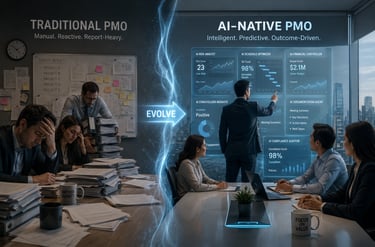
The answer is not that PMOs will become obsolete. Rather, they must transform from administrative control centers into intelligent decision-enablement hubs powered by AI.
The organizations that embrace this transformation will gain significant advantages in speed, efficiency, and strategic execution. Those that do not risk falling behind in an increasingly data-driven world.
The Evolution of the PMO
Understanding where PMOs are headed requires understanding where they have come from.
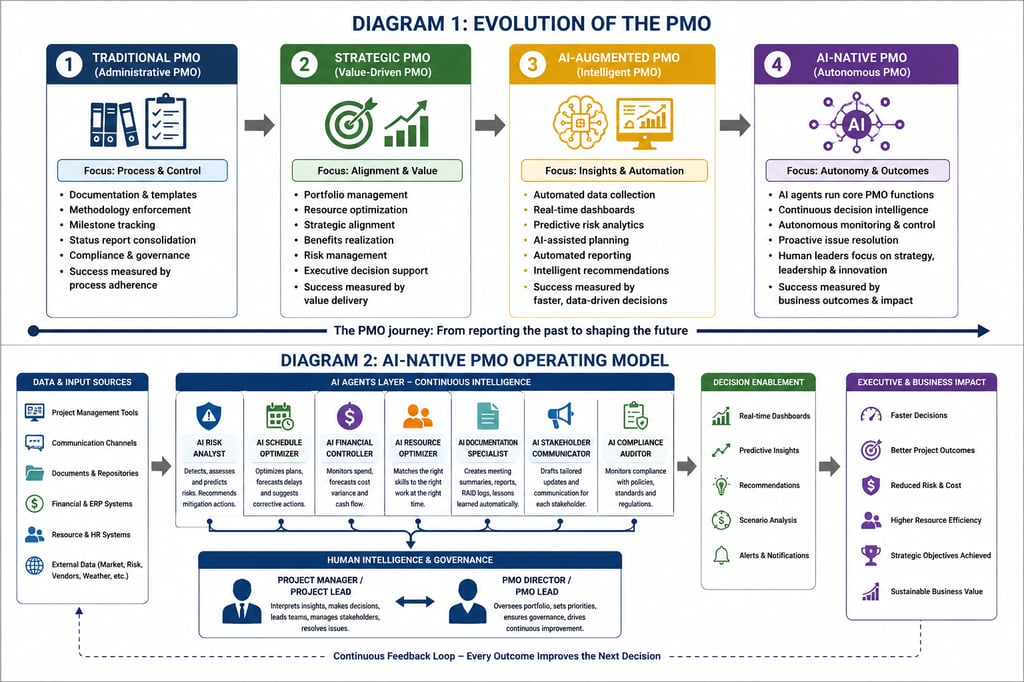
Phase 1: Administrative PMO
In the early years, PMOs primarily focused on documentation and governance. Their responsibilities included:
Maintaining project documentation
Enforcing project methodologies
Tracking milestones
Consolidating status reports
Ensuring compliance with organizational standards
Success was often measured by consistency and process adherence.
Phase 2: Strategic PMO
As organizations matured, PMOs became strategic partners rather than purely administrative offices.
Responsibilities expanded to include:
Portfolio management
Resource optimization
Strategic alignment
Benefits realization
Executive decision support
Technology improved reporting, but much of the analysis still depended on manual effort.
Phase 3: AI-Augmented PMO
Today, organizations are entering a new phase.
Instead of spending hours collecting project updates, AI systems can automatically:
Summarize meetings
Generate project reports
Predict schedule delays
Detect budget anomalies
Identify resource conflicts
Recommend mitigation strategies
Monitor stakeholder sentiment from communication channels
Project managers are gradually spending less time gathering information and more time making informed decisions.
What Is an AI-Native PMO?
An AI-native PMO is not simply a traditional PMO using AI tools.
It is a PMO designed around AI as a core capability rather than an optional enhancement.
Instead of humans manually collecting, organizing, and interpreting project data, intelligent systems continuously perform these activities in real time.
Human professionals then focus on:
Strategic thinking
Leadership
Governance
Ethical oversight
Organizational change
Executive communication
Complex decision-making
The objective shifts from producing reports to enabling better business decisions.
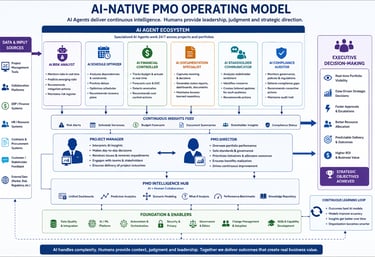
The Emergence of Specialized AI Agents
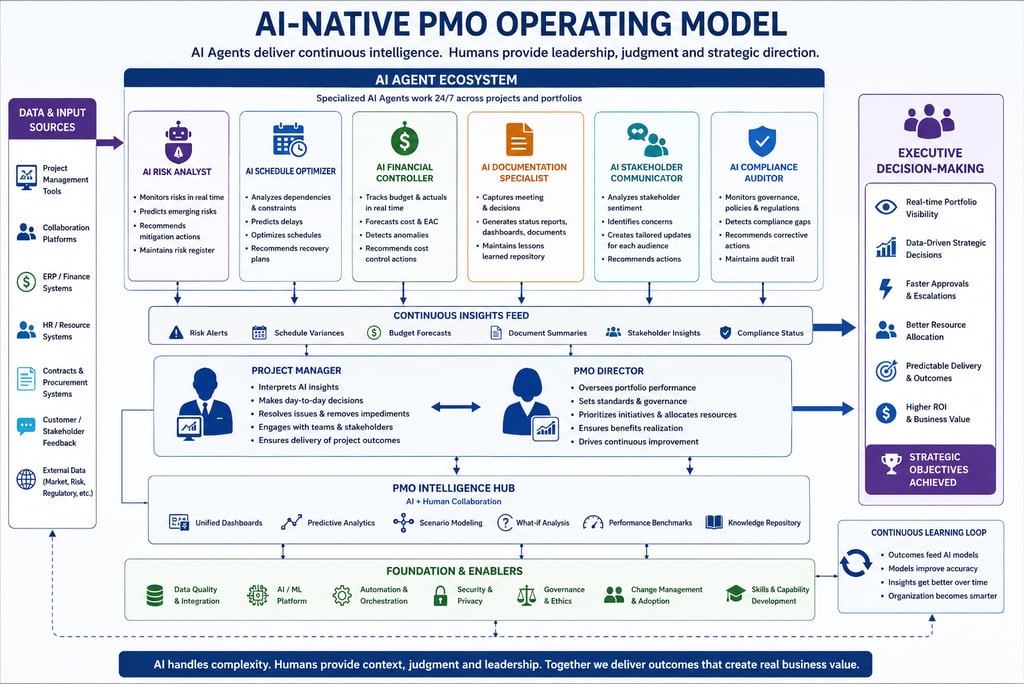
One of the most significant developments in project management is the rise of specialized AI agents. Unlike a single chatbot, AI agents can be designed with specific responsibilities and work together as a coordinated system.
Examples include:
AI Risk Analyst
Continuously monitors project data, identifies emerging risks, and recommends mitigation actions before issues escalate.
AI Schedule Optimizer
Analyzes task dependencies, resource availability, holidays, and historical performance to recommend optimized schedules.
AI Financial Controller
Monitors project spending in real time and forecasts budget overruns before they occur.
AI Documentation Specialist
Automatically generates meeting minutes, project charters, status reports, and lessons learned documentation.
AI Stakeholder Communication Agent
Produces customized project updates for executives, sponsors, customers, and delivery teams.
AI Compliance Auditor
Checks project activities against governance frameworks, regulatory requirements, and internal policies. Together, these agents create an ecosystem that supports project managers rather than replacing them.
What Will Humans Continue to Do?
Despite rapid advancements, AI cannot replicate many of the capabilities that define exceptional project leadership.
These include:
Building trust with stakeholders
Resolving organizational conflicts
Negotiating competing priorities
Leading change initiatives
Coaching teams
Exercising ethical judgment
Navigating political dynamics
Making decisions under uncertainty
Project management has always been about people as much as processes. AI can enhance decision-making, but leadership remains fundamentally human.
Challenges Organizations Must Address
The transition to AI-native project management is not without obstacles. Organizations must carefully consider:
Data Quality
AI systems depend on accurate and complete project data. Poor data leads to unreliable recommendations.
Governance
Clear accountability is essential when AI influences project decisions.
Security
Project information often contains sensitive financial, contractual, and strategic data.
Ethical Considerations
Organizations must ensure AI recommendations remain transparent, unbiased, and aligned with organizational values.
Change Management
Technology adoption succeeds only when people understand, trust, and effectively use new capabilities.
What Skills Will Future Project Managers Need?
As AI becomes embedded in project delivery, the expectations placed on project professionals will evolve.
Future project managers will increasingly need competencies such as:
AI literacy
Data interpretation
Prompt engineering
AI governance
Strategic portfolio thinking
Business transformation
Product management
Human-centered leadership
Technical project management knowledge will remain valuable, but the ability to work effectively alongside AI will become a defining professional capability.
Looking Ahead to 2030
By 2030, many routine PMO activities are likely to be highly automated.
Project updates may be generated automatically.
Risks may be predicted before they appear on traditional dashboards.
Resource conflicts may be resolved through intelligent optimization.
Executive reports may be created instantly based on live project data.
Yet organizations will still need experienced project leaders to provide strategic direction, build alignment, inspire teams, and make complex decisions where technology alone is insufficient.
The future PMO is therefore unlikely to disappear.
It is far more likely to become an intelligent orchestration center where humans and AI collaborate to deliver better outcomes.
Final Thoughts
The question facing today's project professionals is not whether AI will change project management—it already is.
The more important question is whether organizations are prepared to redesign the PMO for this new reality.
Traditional PMOs were built for an era in which information was scarce, reporting was manual, and decision-making was slow.
AI-native PMOs are being designed for a world where data is abundant, insights are generated continuously, and leaders are expected to make informed decisions at unprecedented speed.
For project managers, this transformation presents an opportunity rather than a threat.
Those who combine strong leadership, business understanding, and AI capabilities will be well positioned to lead the next generation of enterprise transformation.
Author's Note
The PMO of the future will not be defined by the number of reports it produces, but by the quality of decisions it enables. As AI continues to reshape the profession, the most successful project leaders will be those who view technology not as a replacement for human expertise, but as a powerful partner in delivering value.