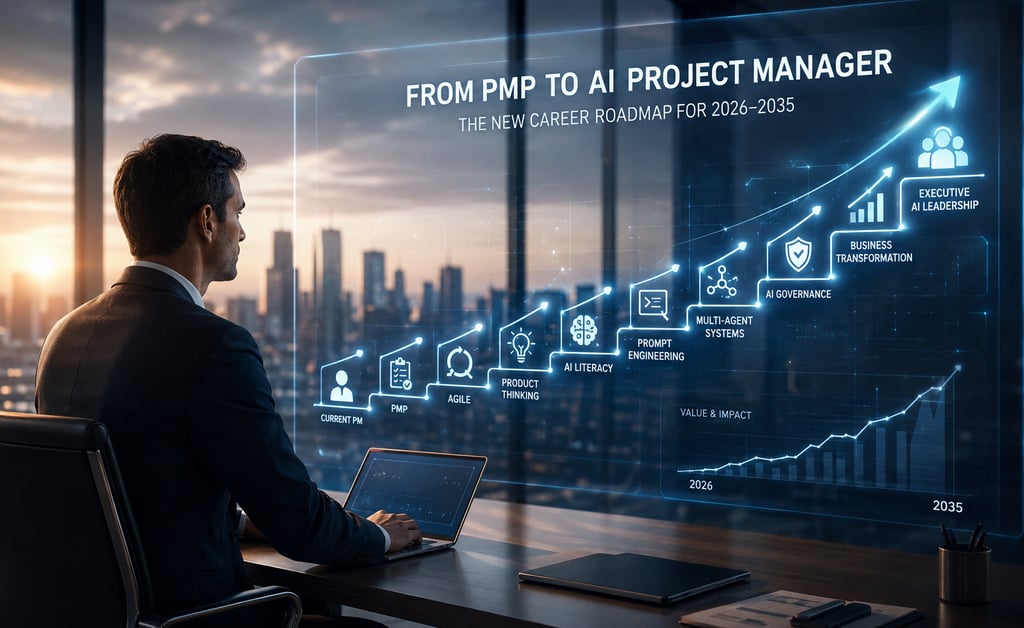
From PMP to AI Project Manager:The New Career Roadmap for 2026–2035
From PMP to AI Project Manager: The New Career Roadmap for 2026–2035 explores how the role of project managers is rapidly evolving in the age of Artificial Intelligence. This practical career guide outlines a step-by-step roadmap—from mastering PMP and Agile to developing Product Thinking, AI Literacy, Prompt Engineering, Multi-Agent Systems, AI Governance, Business Transformation, and Executive AI Leadership. It also examines hiring trends, salary growth, future-ready certifications, in-demand skills, and the common mistakes professionals make while preparing for the next decade. Whether you're an aspiring project manager or an experienced leader, this article provides a realistic strategy to build a future-proof career where humans don't compete with AI—they lead it.
From PMP to AI Project Manager:The New Career Roadmap for 2026–2035
Why the Best Project Managers Won't Be Replaced by AI—They'll Learn to Lead It
By a PMP & Agile Professional's Perspective
Introduction
A decade ago, earning a PMP certification was often enough to stand out in the project management profession. Organizations needed professionals who could manage scope, schedule, cost, quality, risks, procurement, and stakeholders.
Today, that expectation has changed.
Modern project managers are no longer expected to simply manage projects—they are expected to manage change, technology, AI-driven teams, and increasingly, autonomous AI agents working alongside humans.
Between 2026 and 2035, project management will likely experience its biggest transformation since Agile became mainstream.
The question is no longer:
"Will AI replace project managers?"
The more practical question is:
"Which project managers will learn to manage AI better than everyone else?"
This article outlines a practical career roadmap based on current market trends, enterprise AI adoption, and the evolving expectations of global organizations.
The Career Evolution Roadmap
Project Coordinator
↓
Project Manager
↓
PMP Certified
↓
Agile Practitioner
↓
Product Thinking
↓
AI Literacy
↓
Prompt Engineering
↓
Multi-Agent Systems
↓
AI Governance
↓
Business Transformation
↓
Executive AI Leadership
Each step builds on the previous one rather than replacing it.
Stage 1 — Build a Strong Project Management Foundation (2026)
Core Skills
Every successful AI project still depends on strong project management fundamentals.
You should be comfortable with:
Scope Management
Cost Control
Schedule Management
Risk Management
Procurement
Stakeholder Communication
Quality Management
Governance
Leadership
AI can generate project plans.
It cannot replace judgment during difficult stakeholder conversations or resolve organizational conflicts.
That remains a human responsibility.
Recommended Certifications
PMP
CAPM (for beginners)
PRINCE2 (optional depending on region)
Stage 2 — Master Agile Delivery
Modern organizations rarely deliver projects using pure waterfall.
Instead, they combine:
Agile
Hybrid
Incremental Delivery
Lean practices
Project managers increasingly collaborate with:
Scrum Teams
Product Owners
Architects
UX Designers
Data Scientists
Understanding Agile is no longer optional.
Skills to Learn
Scrum
Kanban
SAFe basics
Backlog prioritization
Sprint Planning
Agile estimation
Value delivery
Valuable Certifications
PMI-ACP
PSM
SAFe POPM
Stage 3 — Learn Product Thinking
This is where many project managers struggle.
Projects deliver outputs.
Products deliver outcomes.
Organizations increasingly value professionals who understand:
Customer problems
User experience
Market validation
Product lifecycle
Metrics
Continuous improvement
Instead of asking:
"Did we finish the project?"
Product-oriented leaders ask:
"Did we create measurable business value?"
Learn
Customer Discovery
Product Roadmaps
Design Thinking
OKRs
Product Metrics
Business Value Measurement
Stage 4 — Become AI Literate
This is the first major shift for the next decade.
AI literacy doesn't mean becoming a data scientist or machine learning engineer.
It means understanding:
What AI can realistically do
Where AI struggles
Which tasks should remain human-led
How AI fits into business processes
An AI-literate project manager knows when to automate and when human oversight is essential.
Learn
Generative AI
Large Language Models
Retrieval-Augmented Generation (RAG)
AI limitations
AI ethics
AI risks
Enterprise AI adoption
Stage 5 — Learn Prompt Engineering
Most professionals think prompt engineering is about writing clever prompts.
Enterprise prompt engineering is different.
It focuses on creating structured, repeatable instructions that consistently produce reliable outputs.
Project managers may use prompt engineering to:
Draft project charters
Generate RAID logs
Prepare stakeholder updates
Create sprint retrospectives
Analyze project risks
Build communication plans
Produce executive reports
The goal isn't to replace thinking—it's to reduce repetitive work while maintaining quality.
Stage 6 — Understand Multi-Agent Systems
This is likely to become one of the defining capabilities of AI-enabled project managers.
Today's AI tools often respond to one prompt at a time.
Tomorrow's enterprise environments will involve teams of specialized AI agents working together.
Examples include:
Planning Agent
Risk Agent
Finance Agent
Compliance Agent
Procurement Agent
Scheduling Agent
Reporting Agent
Documentation Agent
Quality Agent
Instead of personally completing every task, project managers will increasingly coordinate human teams and AI agents working in parallel.
The role shifts from task execution to orchestration.
Stage 7 — Learn AI Governance
As AI becomes part of enterprise operations, governance becomes critical.
Organizations must ensure AI systems are:
Secure
Transparent
Fair
Compliant
Auditable
Project managers who understand AI governance will be valuable in regulated industries such as banking, healthcare, government, pharmaceuticals, insurance, and aerospace.
Key topics include:
Responsible AI
Data Privacy
Model Risk
Human Oversight
Regulatory Compliance
AI Policies
Stage 8 — Drive Business Transformation
Technology alone doesn't transform organizations.
People do.
This stage focuses on leading enterprise-wide change rather than delivering isolated projects.
Key capabilities include:
Process redesign
Organizational change management
AI adoption strategy
Digital transformation
Enterprise portfolio alignment
Value realization
This is where project management becomes a strategic business function.
Stage 9 — Executive AI Leadership
By 2035, many organizations are expected to have executives responsible for enterprise AI strategy.
Future leadership roles may include:
Director of AI Programs
Head of AI Transformation
AI Portfolio Director
VP of Enterprise Automation
Chief AI Strategy Officer
Chief Transformation Officer
These leaders will shape how AI supports business goals, governance, and long-term competitiveness.
Salary Outlook (Indicative Global Trends)
While salaries vary by country, industry, and experience, market direction suggests that professionals who combine project management expertise with AI capabilities are likely to command higher compensation than those relying only on traditional delivery skills.
Career StageTypical Global Salary (USD)Project Manager$70k–110kSenior PM$100k–150kAgile Project Manager$110k–160kProduct & Delivery Leader$130k–190kAI Project Manager$150k–220kAI Transformation Manager$180k–280kExecutive AI Leader$250k–500k+
These ranges are indicative and vary significantly by region, industry, company size, and individual experience.
Hiring Demand Through 2035
Organizations are not simply hiring "AI experts."
They are seeking professionals who can bridge business strategy, technology, and execution.
The strongest demand is expected for individuals who combine:
Project Management
Agile Delivery
Product Thinking
AI Integration
Business Transformation
Leadership
In other words, companies increasingly need translators who can align business goals with technical capabilities.
Future Certifications Worth Considering
The certification landscape is evolving. Rather than collecting credentials, focus on those that complement your experience.
A balanced roadmap could include:
Foundation
PMP
PMI-ACP
Scaling Delivery
SAFe POPM
SAFe Scrum Master (if relevant)
Product
Product Management or Product Owner training
AI
AI fundamentals for business professionals
Prompt engineering workshops
Enterprise AI governance programs
Leadership
Change Management
Business Architecture
Digital Transformation
Executive Leadership programs
The value comes from applying these skills in real projects, not from the number of certificates on a résumé.
Common Mistakes Professionals Make
Many talented project managers slow their career growth by making avoidable mistakes.
Some of the most common are:
Collecting certifications without applying the knowledge. Hiring managers increasingly ask for evidence of impact, not just exam badges.
Ignoring AI because it feels too technical. AI literacy is becoming a business skill, not only an engineering skill.
Learning tools instead of concepts. Today's popular AI platform may be replaced in a few years. Understanding workflows, governance, and problem-solving has a longer shelf life.
Neglecting communication and leadership. AI can summarize meetings, but it cannot build trust, negotiate priorities, or navigate organizational politics.
Avoiding product thinking. Delivering a project on time is valuable, but delivering measurable business outcomes is what senior leaders remember.
The Skills That Will Remain Uniquely Human
As AI automates more operational work, certain capabilities become even more valuable:
Strategic decision-making
Leadership
Stakeholder influence
Negotiation
Ethical judgment
Conflict resolution
Organizational change leadership
Vision setting
Coaching and mentoring
Building high-performing teams
These are the qualities that distinguish leaders from coordinators.
Final Thoughts
The next decade will not eliminate the role of the project manager—it will redefine it.
Routine administrative tasks will increasingly be handled by AI. Reporting will become more automated. Planning will become more data-driven. Documentation will be generated in seconds rather than hours.
The project manager of 2035 will spend less time creating status reports and more time making strategic decisions, aligning stakeholders, governing AI-driven delivery, and enabling business transformation.
The most successful professionals won't compete with AI. They'll learn how to lead teams where humans and AI work together toward shared outcomes.
If you're a project manager today, the path forward is clear: strengthen your fundamentals, embrace Agile, think like a product leader, become fluent in AI, understand governance, and develop the leadership skills that technology cannot replace. Those who follow this progression will be well positioned to shape—not just survive—the future of project management.