
Agentic AI in Project Management: From Task Execution to Autonomous Decision-Making
This article explores how agentic AI is transforming project management from traditional task execution into autonomous decision-making. It examines the unique capabilities of AI agents—such as risk analysis, compliance monitoring, stakeholder communication, and agile facilitation—and highlights industry research showing their growing impact. The piece emphasizes how project managers must evolve from manual oversight to orchestrating hybrid teams of humans and AI agents, ensuring strategic alignment and ethical governance. By 2030, the most successful managers will be those who integrate agentic AI into their workflows to achieve efficiency, adaptability, and competitive advantage.
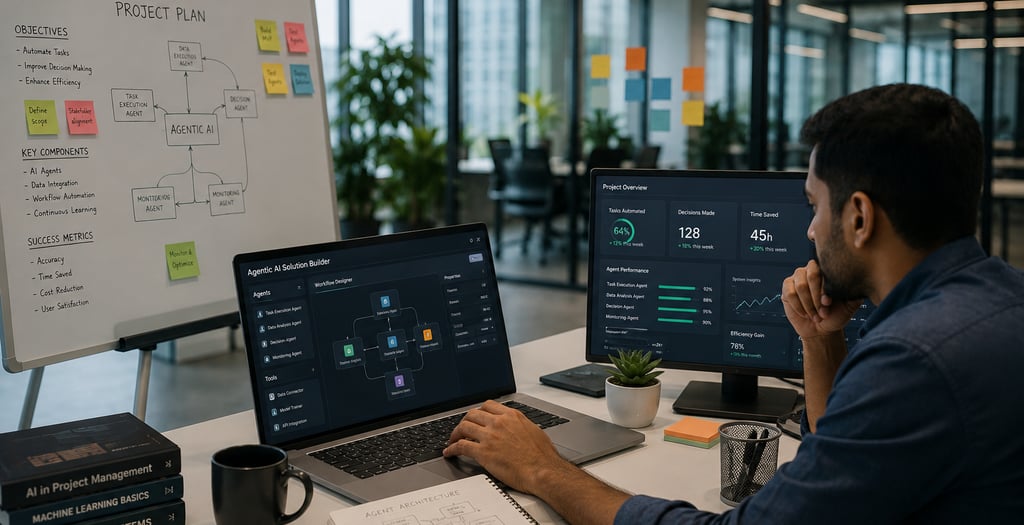

Agentic AI in Project Management: From Task Execution to Autonomous Decision-Making
Introduction Project management has historically been defined by human oversight, with managers coordinating tasks, monitoring risks, and ensuring delivery. Tools such as ERP systems, Gantt charts, and collaboration platforms have supported this work, but the responsibility for judgment and decision-making remained human. The rise of agentic AI—AI systems capable of autonomous, goal-driven actions—marks a fundamental shift. These agents are not just automating repetitive tasks; they are beginning to make decisions, adapt strategies, and collaborate with human managers in real time.
Defining Agentic AI in the Project Context Agentic AI differs from traditional AI in its autonomy. Instead of requiring explicit instructions, agentic AI agents can interpret objectives, identify risks, and act toward achieving defined goals. They are designed to operate within constraints, learn from historical data, and adapt dynamically. This makes them particularly suited to project environments where uncertainty and complexity are constant.
Applications in Modern Project Management Offices (PMOs)
Risk Management – AI agents can continuously monitor project data, identify early warning signals, and run simulations to recommend mitigation strategies.
Compliance Oversight – Agents can ensure adherence to regulatory frameworks such as ISO standards or GDPR by monitoring documentation and workflows.
Stakeholder Communication – AI agents can draft tailored updates for executives, clients, and teams, adjusting tone and detail automatically.
Agile Facilitation – AI agents can act as digital scrum masters, facilitating ceremonies, tracking sprint progress, and highlighting bottlenecks.
Industry Evidence and Research
Gartner forecasts that by 2030, over 80% of project management tasks will be performed by AI agents.
PMI’s Pulse of the Profession highlights that organizations adopting AI in project management already report efficiency gains of 20–30%.
Case studies in IT services show AI-driven scheduling reducing project delays by up to 25%.
Implications for Project Managers The role of the project manager will evolve significantly:
From manual task execution to supervising AI ecosystems.
From tactical oversight to strategic alignment of AI-driven decisions with organizational goals.
From process monitoring to ethical governance of AI use.
From managing human-only teams to orchestrating hybrid teams of humans and AI agents.
Conclusion Agentic AI is not replacing project managers—it is redefining their responsibilities. By 2030, successful managers will be those who integrate autonomous agents into their workflows, balancing human judgment with machine-driven efficiency.